
Franklin Township Previous Residents by Era
A backward address trail changes as it crosses record eras. Franklin Township's current assessment data is a useful first link, but it is not a complete history. Somerset County land records carry the recorded transfer trail. Directories, newspapers, maps, tax ratables, census images, and archival listing sheets can then fill intervals where a deed says nothing about a household. Each source below has a separate keeper and a different level of certainty.
| Source | Years or period | Where held | What it shows |
|---|---|---|---|
| Somerset Acclaim land index | Later electronic material; pre-January 1, 1977 uses Alpha Index | County Clerk portal and record room | Grantor/grantee, type, date, legal description, book/page or instrument, consideration, and image. |
| Alpha Index and deed books | Before January 1, 1977 | County Clerk, older microfilm, Archives, and FamilySearch paths | Earlier grantor-grantee chain and instruments. |
| Franklin TaxDataHub | Current assessment data; historical depth not stated | Online assessor route | Current parcel, owner, property, and sales filters. |
| Franklin tax ratables | 1802, 1806, 1808, 1815, and 1825 | New Jersey State Archives | Early owner, occupier, and taxable-property context. |
| Regional directory runs | 1917 through 1987 runs vary by collection | State Library, Rutgers, and SCLSNJ | Dated listed name, address, and regional code. |
| Rutgers County MLS | 1976 through 1991 | Rutgers Special Collections, off-site | Address, municipal or tax-map location, listing, and sale annotations. |
| Federal census | Released through 1950 | National Archives and authorized library access | Household members and residence on the census date. |
| Franklin newspapers | Title-specific runs from 1948 through 1998 | Franklin Library and Digifind-It | Obituaries, announcements, streets, and civic-event references. |
| Construction permits | Historical start not verified | Construction Code, SDL, or OPRA | Work, applicant, address, block/lot, inspection, and control evidence. |
Start with the present parcel for a recent question, then work toward earlier land instruments. For an older household question, begin with the nearest directory or census date and use the parcel, village, and legal description to test whether it is the same place.
Freeze a Franklin Township Parcel
The first task is to preserve the identity of the current parcel before searching backward. In Franklin Township TaxDataHub, search the situs address and copy the returned property form, block, lot, qualification, owner result, mailing address, and legal-description clues. TaxDataHub has Property, Owner Name, Town, B.L.Q., class, sales, square-footage, and year-built filters. Its visible search fields do not include ZIP.
A situs address is the physical parcel location. A mailing address is where correspondence goes. The values can differ for many reasons and should never be converted into a claim about who was at the site. The Somerset GIS viewer is the next check: it supplies parcel geometry and block/lot context, but current owner names are redacted in its parcel data. Save the source date from each system because its update date may not match a recorded instrument date.
Trace a Somerset County Deed Chain
The deed chain is the central ownership trail for previous residents research. It begins with the current parcel identity and then uses the County Clerk's AcclaimWeb search to locate the most recent matching deed. Search by legal description or block and lot when possible, not merely by a familiar street name. The result should be confirmed through municipality, legal description, party role, and date before it becomes the next link.
- Copy the current parcel and legal-description clues from TaxDataHub, then search Acclaim by legal description or block/lot.
- Open the most recent matching instrument and record grantor, grantee, document number or book/page, record date, consideration, and legal description.
- Treat the grantee as the later link and the grantor as the prior owner candidate. Search the parcel and that grantor again for the earlier transfer.
- Repeat the comparison with municipality, block/lot, legal description, and date. A matching name by itself is unsafe.
- When the trail reaches pre-1977 material, use the Alpha Index, paper deed books, or microfilm at the County Clerk rather than assuming the modern search is complete.
- Grantor and grantee
- The grantor transfers an interest in the recorded instrument; the grantee receives that recorded interest.
- Chain of title
- A sequence of recorded transfers for the same parcel, checked by legal description and dates rather than names alone.
- Legal description
- The land-record identity, often block, lot, qualification, subdivision, or metes-and-bounds language that links changing address forms.
- Instrument
- The recorded document itself, indexed by a number or book and page and then read for party roles and property details.
The Clerk provides indexing guidance but does not perform title searches. Images are available after a free account and email activation, with an unofficial watermark; certified copies cost $10 per instrument plus $1 per page, while ordinary record-room copies are $.07 per page.
Franklin Township Previous Residents and Alpha Index
January 1, 1977 is the practical change point in the County Clerk's published online-search instructions. Records before that date are routed to the Alpha Index section. The exact first electronic year varies by record series, so it is more accurate to describe the online run as later electronic material with an older Alpha Index path than to invent a single starting year.
For a Franklin Township address, carry the street form, village label, block and lot, legal description, and seller or buyer name into the older search. Paper deed books and microfilm at the Clerk are the direct fallback. The New Jersey State Archives genealogy collections and FamilySearch are additional research paths for earlier county deeds, but the exact volume and municipality still need confirmation. The current index is a tool for locating records, not an official opinion about the entire title chain.
Note: The County Clerk's free property-recording notification service is an anti-fraud alert, not a title search or a complete prior-owner report.
Pair Franklin Township Previous Residents With Census
Deeds identify recorded transfers, but a household trail needs dated publication and census evidence as well. Search a directory's alphabetical name section, then check its street or householder guide for the address. Record the printed spelling, initials, spouse notation where present, street number, municipality code, and date. Franklin material can appear in regional New Brunswick or Somerville coverage, so read each volume's coverage line before treating an entry as a township match.
- Choose the directory year nearest the land transfer or known address period and preserve the entry exactly as printed.
- Use the same volume's reverse street section to confirm the number, allowing for village labels, initials, and publication conventions.
- Compare the next earlier or later directory and test road labels, postal names, and cross streets against the parcel identity.
- Pair the interval with a released federal census. Census images now end at 1950 under the 72-year rule.
- Use a newspaper, obituary, probate file, map, or permit as a dated check between the directory and census snapshots.
Directories are not a current roll, and census records are a snapshot on one date. Together, they can provide a more honest past-household timeline than either source alone. The collection shelves and publishers are detailed on the Franklin Township city directory page.
Franklin Township Previous Residents in MLS
Rutgers holds more than 30,000 unbound Somerset County MLS sheets from 1976 through 1991. This is a distinctive address bridge between a deed and a published directory. The collection description lists street, municipal or tax-map location, asking price, age, lot, style, stories, basement, heat, rooms, taxes, remarks, listing period, and sometimes owner contact information. Handwritten notes can add a sale date, agency, sold price, or buyer surname.
The successful Rutgers archive capture documents the Somerset County historical property-listing collection.
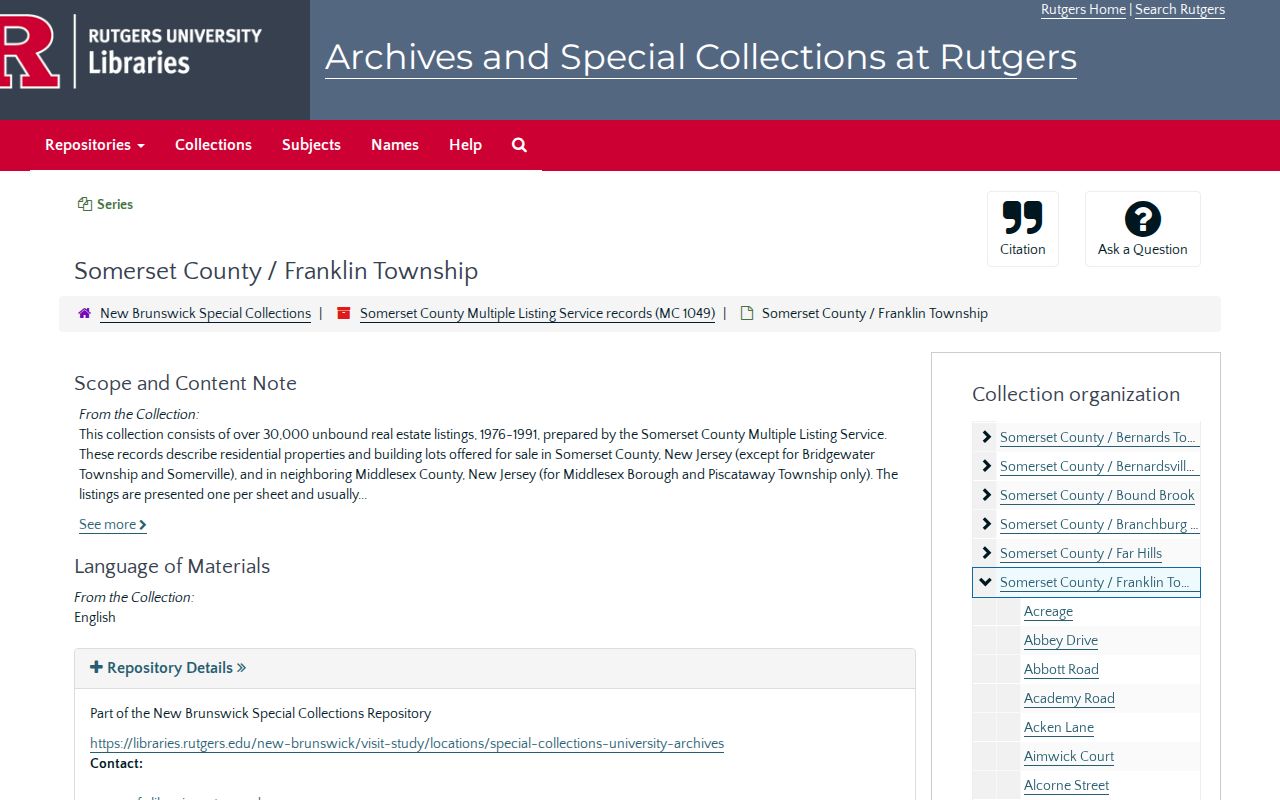
A listing sheet is an archival sales record, not an official deed and not proof of every person at the address. Rutgers Special Collections keeps this collection off-site, so a request needs advance retrieval time.
Franklin Township Ratable Books
Franklin Township has an unusually early property-person trail in surviving tax ratable books. The State Archives guide identifies township books for 1802, 1806, 1808, 1815, and 1825, along with earlier Eastern Precinct material. These books predate modern street-number systems. An owner or occupier name, farm, road line, local map, and later legal description may be the bridge back to the current parcel.
Use the ratables as context, not as a direct street match. Franklin Township was established in 1798, and older records may use an earlier precinct or period label. A ratable record is not a complete list of previous residents at an address; its exact fields and relationship to a later lot must be checked in the source material.
Map a Franklin Township Address Backward
Maps help when a modern number fails. Rutgers guidance identifies 1850, 1873, 1876, 1945, and 1950-era local maps and atlases that can preserve road lines, landowners, village context, and route names. The Library of Congress 1850 Somerset map adds landowner, building, and occupant context. Compare a map label with the legal description and neighboring roads before linking it to a modern parcel.
No Franklin Township Sanborn run was verified in the reviewed official material. Rutgers describes a statewide Sanborn database for 1884 through the early 1950s, but that does not establish that Franklin has a usable run. Use the atlas, county map, tax ratables, and permit evidence instead of claiming a verified Franklin Sanborn sheet.
Past Franklin Township Households
Local newspapers and probate can close gaps in a Franklin Township address timeline. The Franklin Library and Digifind-It provide title-specific newspaper runs from 1948 through 1998. Search surname, spouse, street, village, and date, then verify any obituary or announcement with a vital record, cemetery or church custodian, or a probate file. A newspaper hit is a lead, not a certified record.
The Somerset Surrogate's public probate search can provide name, docket, case type, filed and issued dates, date of death, status, and town fields. It can connect an estate to a deceased person's address or heirs, but the file must be requested from the correct custodian for proof. Construction permits can also date a change to the structure; they do not date ownership by themselves.
Lawful use. Franklin Township past-resident research supports house history, family history, heir research, and personal curiosity. Do not use an address trail to stalk, harass, intimidate, or harm a living person; protected-address rules and New Jersey law apply.
Check Franklin Township Previous Resident Evidence
Keep a small chronology for every candidate: original address wording, postal label, Franklin Township municipality, block/lot, legal description, source date, party role, and the exact source link or shelf reference. This keeps a previous residents search tied to evidence and preserves village labels such as Kingston, Middlebush, East Millstone, Franklin Park, Zarephath, and Somerset without flattening them into one assumed address.
For hard gaps, the Franklin Township Public Library Historical Room is reference-only and has local materials, a copier, and a microfilm reader or printer. The Somerset County Historical Society can perform limited remote research for $30 per two hours with a typical five-to-eight-week turnaround. Ask for specific family files, deeds, maps, or photographs, and retain the source date with any returned finding.